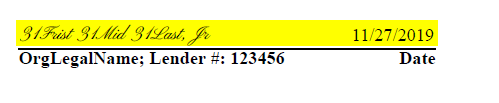
Signature Areas
In many documents a signature is required at various places within the document. Most often a signature is required at the end of a document, sometimes signatures are required within the document on various pages. The Requirements Editor provides a defined set of elements to support the inclusion of signature lines (or signature areas) within a document.
- To define signatures within the body of the document, use the Signature element. This type is often used for credit insurance signatures and notice signatures.
- To define signatures for the entire document or agreement, use the SignatureSection element. This type is typically placed at the end of the document.
- the number of signature lines
- the text to include in the signature lines
- filling a signature area (highlighting)
- adding a box around the signature area
- For signatures within the body of the document the
Signature element (one Signature element for each signature
line needed) is used along with the necessary children. The following output
would be produced based on the REQ structure shown below.
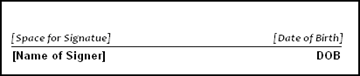
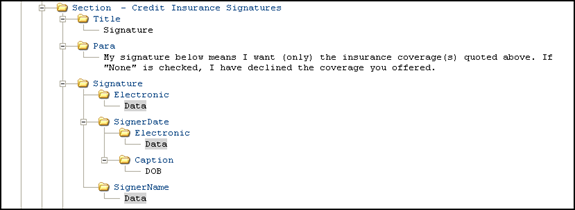
- For agreement signatures: use the SignatureSection element;
depending on the type of document the children of Signature will vary.
The standard for static documents is to have two entity signature blocks and two
individual signature blocks. Standard structure for an entity signature block
(each entity block should be in its own SignatureGroup):
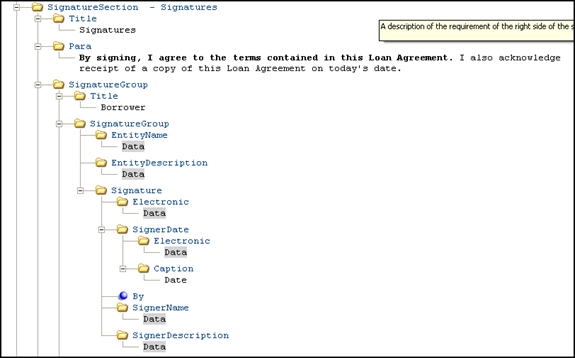 The output would look resemble the following:
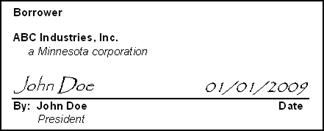 Note: When generating REQs with multiple SignatureSection elements, each subsequent SignatureSection element is indented .2" from the previous.
 - The By element is not used as a general rule, but is available for commercial documents if required. Standard structure for an individual signature block (not required to be in separate SignatureGroups) resembles the following:
- The Lender signature is another SignatureGroup
within the SignatureSection. The standard structure resembles the
following:
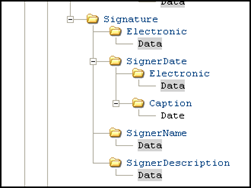
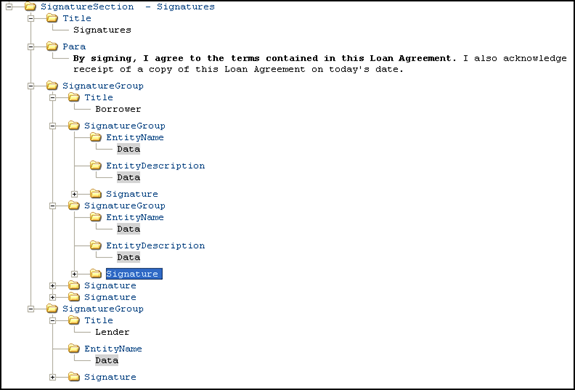
- The structure for the entire SignatureSection at a high
level would resemble the following:
- Witness and notaries will use the same signature structure.
| Element | Description |
|---|---|
| By | Including the By element will trigger the stylesheet to include “By:” before the signer name below the signature line. |
| Caption | Used to indicate what caption should be used below
the Signature or SignerDate area. Typically Date or
DOB (Date of Birth).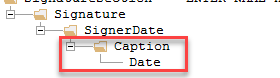 |
| EnableHighlight: | This element is used to enable highlighting within an REQ when present at the document level. The element enables the SignatureHighlightColor attribute. If this element is not present in a document, highlighting is disabled, even if the SignatureHighlightColor attribute is defined. |
| EntityName | The entity name. Note: Special
characters are not allowed as part of the EntityName value. If invalid characters are
entered, a message will appear indicating the use of invalid characters and will
prompt you to change the value. |
| EntityDescription | The entity description (ex. a Minnesota corporation). |
| HighlightSignaturesInd | This element is used as a flag (Boolean type) where the default value is False (0). A false value disables the highlighted signatures feature. A true value (True = 1) enables the feature. If submitted as true, the target signature block in the transaction data is highlighted in the defined manner in the output if both the EnableHighlight element is present in the document and the SignatureHighlightColor attribute defined |
| InternalReference | Allows you to reference an existing witness/seal source. |
| InternalSource | Allows you to provide a single source to use as witness/seal content. This would be referenced by InternalReference. |
| LinkToSignerIdentifier | Provides the ability to link witness and notary signature fields to the signer of the document. This optional element is used with Signature and SignatureField elements only. |
| Notice | standard notice |
| Para | standard para. |
| Seal | Including the Seal element will trigger the stylesheet to include (seal) below the signature line. |
| SignatureGroup | Used to group multiple signatures together or group
Entity Name and Description with a signature.
There can be multiple levels of SignatureGroups. Tip: To prevent multiple SignatureGroup elements
from spanning across pages, add the KeepTogether
attribute to the first SignatureGroup
element. See also: SignatureGroup Element |
| SignatureGroup/Title | The name given to the group of signatures (ex. Borrower, Seller, Lender). |
| SignatureSection/Title | The title of the SignatureSection. Formatted the same way a standard section title would be. |
| SignerDate | Included if the signature line should be dated
(signature date or date of birth). Notary and Witness signatures do
not require dates. |
| SignatureField | Allows you to author a SignatureField element directly. The
SignatureField element is available only as a child to the
FragmentedPara element and contains the following child elements:
Note:
|
| SignatureDateField | Allows you to author a SignatureDateField element directly. The
SignatureDateField element is available only as a child to the
FragmentedPara element and contains the following child elements:
Note:
|
| SignerDescription | Can include the signer title or information for Power of Attorney. For some consumer products the signer description may not be included to save space. |
| SignerName | Used to indicate the signer name should print below the signature line. |
StaticSignature Element
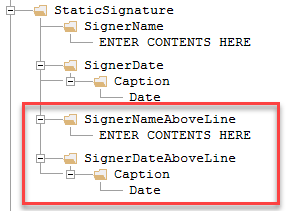
There may be instances in which a static signature must be added above the signature line. The StaticSignature element is provided for these instances.
The StaticSignature element is present wherever the Signature element is located. Only one instance if the StaticSignature element is allowed.