In most cases you will be working with a collection of files contained
within a repository when creating new files or modifying existing files. Requirements
Editor allows you to open a content file (REQ or other XML file) that is contained
either within or outside of a repository. There are several different ways to access
files for authoring; for example, you might
- copy a file or group of files from a repository in a build folder
to your local machine,
- work directly in a repository on your local machine or network
share, or
- access a repository from a content library contained on a CD or
other media.
Each REQ file is associated with a repository through the content
references contained in the file. While you can author an REQ outside of a repository,
the content references must resolve to the repository to which they point. These
pointers are defined in the Authoring Web Service that the Requirements Editor is
configured to access in
Options. In order for an REQ to resolve
content references and successfully generate a document, Requirements Editor must be
pointed to a valid repository accessible to the Authoring Web Service. The Expere
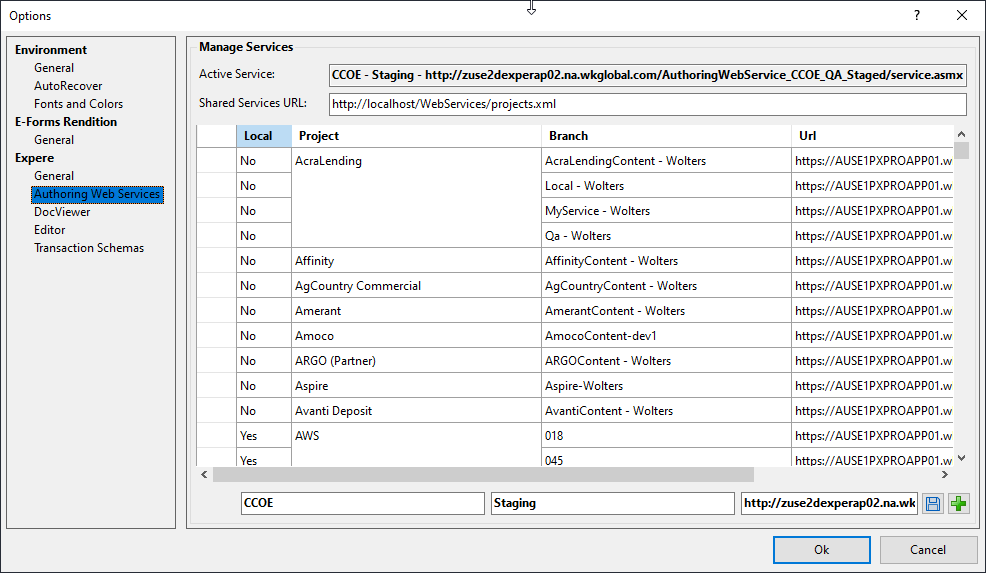
Authoring Web Service is defined in the
Authoring Web Services
section of the
Options window ().
Note: The
Web Service
Indicator on the Toolbar allows you to connect and disconnect
from Web Services. This indicator button is available only when no document is
opened within Requirements Editor.
Multiple Authoring Web Service Configuration
There are times that an author will be working two or more Content Repositories and
will need to be able to update content depending on the repository. For details on
configuring Web Services, refer to Authoring Web Services.
About the Expere Knowledge Base Repository
Content is often accessed through an Expere Knowledge Base repository
corresponding to a particular release, build, or line of business. Most often,
content is saved back to the same repository or new content files are created and
saved to a particular repository.
An Expere Knowledge Base repository contains content that, ultimately,
is used to generate compliance documentation for financial transactions. For the
purposes of this guide, there will be two repositories discussed: the authoring
repository, where custom content is created and integrated with Wolters Kluwer
content, and the build repository, which may be deployed to a production environment
or to another environment such as testing. The content in the authoring repository
will generally be under some type of source control or content management system
that will place (“check out”) files on the file system to be edited. You can open
these files from the file system into Requirements Editor.
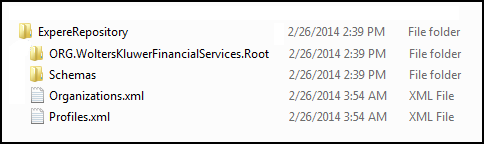
When installed, the standard repository structure consists of a file
system folder containing a folder named
WoltersKluwerFinancialServices.root, which contains Expere
content organized in sub-folders, and an XML file,
Organizations.xml, that contains information about the
repository structure. Within the repository root, the repository is organized to
contain folders for each line of business (LOB). From a customer perspective, each
LOB is licensed independently. Consequently, Wolters Kluwer has organized the
repository folder structure to contain a folder for each LOB. The folder structure
also contains common and shared files that are used across LOBs. At the LOB root
folder, the repository is contained in the
ExpereRepository
folder and will look something like this: