The following sections contain detailed information on each command located within the menu bar.
Note: Some menu items are context sensitive, meaning that options are enabled and disabled depending on where you are in the application and the features available to you based on the Requirements Editor edition and advanced features you have installed.
File Menu
- New – Mainly used for creating dynamic, inherited, or static documents. You can also select and create various types of transactions, as well as REQ Diff Editor files (for merges).
- Open – Used to open REQ files as well as transaction XML files.
- Close – Closes the file that currently has focus in the tool. This will close transaction XML or REQ files.
- Merge Sessions (New, Open, and Close) – These menu options are for the new merge tool functionality (refer to the Merge Tool section for details). Not included in the FOP or XEP installs.
- Save/Save As/Save All – Used to save changes made to the file that has focus in the tool. Save All saves all files that are open in the tool, regardless of if they have focus.
- Properties – Shows the different properties of the document that currently has focus.
- Page Setup/Print Preview/Print – All of these options relate to printing.
- Recent Files – This menu option allows you open files that you had worked with recently.
- Exit – Closes the application.
Edit Menu
- Undo/Redo – Undo/Redo the last change that was made.
- Cut/Copy/Paste – Works like normal Cut/Copy/Paste functionality. You can use these three options on elements in the “Outline Editor” tab.
- Duplicate – Only usable in the “Outline Editor” tab. This creates a copy of the currently selected element (or elements). The copy is added to the tab.
- Move Up/Down – Only usable in the “Outline Editor” tab. This moves the currently selected element (or elements) up or down in the tree structure of elements.
- Decrease/Increase Indent – Only usable in the “Outline Editor” tab. This will move the currently selected element (or elements) to a shallower or deeper level in the tree structure of the elements.
- Find – Normal find functionality. It works in many RE 3 windows/tabs.
- Replace – Normal replace functionality. Users should avoid using this functionality for the time being.
- Incremental Search – Built in Visual Studio functionality. Currently, this does nothing. Users can ignore this for now.
- Go To – Built in Visual Studio functionality. Currently, this does nothing. Users can ignore this for now.
- Navigate To – Built in Visual Studio functionality. Currently, this does nothing. This can be ignored.
View Menu
- Doc Viewer – Allows you to see the document through a Doc Viewer web interface (a web page). Not included in the FOP or XEP installs.
- Expand/Collapse All – Only usable in the “Outline Editor” tab. This expands or collapses all tree nodes in the tab.
- Messages – Built in Visual Studio functionality. Currently, this window/tab shows nothing. Users can ignore this for now.
- Merge Session – Only applies to merges. Makes the merge session windows appear. Not included in the FOP or XEP installs.
- REQs Diffs – Only applies to merges. Makes the REQ Diffs window appear. Not included in the FOP or XEP installs.
- Content Item Diffs – Only applies to merges. Makes the Content Item Diffs window appear. Not included in the FOP or XEP installs.
- Incoming REQ – Only applies to merges. Makes the Incoming REQ window appear. Not included in the FOP or XEP installs.
- Existing REQ – Only applies to merges. Makes the Existing REQ window appear. Not included in the FOP or XEP installs.
- Shared Content Diffs – Only applies to merges. Makes the Shared Content Diffs window appear. Not included in the FOP or XEP installs.
- Merge Notes – Only applies to merges. Makes the Merge Notes window appear. Not included with the FOP or XEP installs.
- Other Windows – Clicking on each of these options will show their respective window/tab. These options (minus Dynamic Help) are also tabs on the bottom of your “Outline Editor” tab.

- Toolbars – Allows you change which toolbars appear. You can also customize the toolbars and menu options.
- Full Screen – Changes the view to a full screen one.
Static Menu
Note: These options appear for static documents only.
- Find Rules for this Public Name – Used to find rules for a given public name.
- Find Definition for this Public Name – Used to find definitions for a given public name.
- Find Rules and Definitions for All Public Names – Performs a combination of the two options above.
- Verify Revised Rules – Verifies any revisions for rules.
- Import/Export xTemplate – Used to import or export xTemplates for static documents.
- Continuation Page Setup – Used to add continuation pages to static documents.
Merge Menu
Note: These options appear for internal installations or Requirements Editor 3.
- Generate Results & Update Content References – Performs the function of the next two options.
- Generate Results Only – Creates all the folders and files containing the merge results.
- Update Content References – Updates the content references present in the merge session.
- Expere Content Build ERL Format – Builds the repository content in the ERL format.
- Generate Impact Analysis Report – Creates a webpage detailing the differences between the repositories.
Transaction Menu
- Create Transaction from Document Rules – You can opt to create a transaction internally or externally. If a user opts for an external transaction, they create a transaction xml file and then build it within RE 3. The external transaction isn’t linked to the REQ, rather it’s treated as another tab for just working on that xml.
- Import Transaction – Used to import transaction XML.
- Save Transaction As – Used to save transactions.
- Change Transaction Name – Used to change the name of transactions.
- Validate Transaction – Used to validate whether the transaction XML is correctly constructed.
Assembly Menu
- Build – Runs a syntax check on REQs. Any incorrect structure or PTR will show build errors.
- Execute Document – Creates and displays a PDF version of the document, based on the transaction XML you provide.
- Execute Package Rules – Creates and displays a PDF which outlines each package rule and if the document was autoselected or suggested for each of them.
Tools Menu
- Find Forms Using this Rule – Shows documents that use a given rule. This option only appears for static documents.
- Export Field Grid – Used to export the field grid contents as an Excel document.
- Spell Check – Performs a spell check. Currently, this has limited use.
- Update Style Sheets – Gets updated versions of style sheets used for authoring.
- Add Custom Fonts – Allows a user to add custom fonts for their content.
- Customize – Lets you customize your menu options and toolbars. Users shouldn’t need to use this.
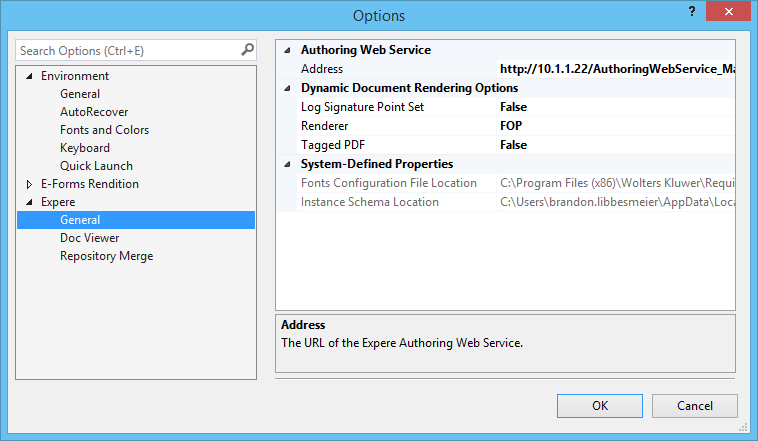
- Options – Displays an options window where various settings for RE 3 reside.
Rendition Menu
Note: These options are not included in the FOP or XEP versions of Requirements Editor 3.
- Create Renditions – Used to create different file format versions of the REQ file.
- Edit Instances – Used for EPM documents. Allows you to edit the different instances for a document.
Window Menu
All of the menu options are used to select and position the windows and tabs.
Help Menu
- Requirements Editor Help – Opens the online help webpage.
- About Requirements Editor – Displays version information and installed packages.
