Understanding Precedence
Precedence is a feature of the Expere Knowledge Base that allows custom content to supersede base content using a combination of inheritance and overrides. Precedence is applied by Precedence Units, which are discrete collections of content that are organized hierarchically. You may need to apply custom content to a specific Precedence Unit that will then be inherited by any child unit that does not override it.
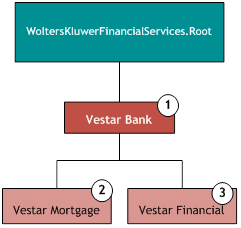
Wolters Kluwer Financial Services is always the root (parent) Precedence Unit, at the top of the hierarchy and custom content resides in sub-levels below, as illustrated in the figure below. Any custom content in the Vestar Bank precedence unit will automatically apply to the Vestar Mortgage and Vestar Financial precedence units. Custom content in the Vestar Mortgage precedence unit will only apply to Vestar Mortgage and, likewise, custom content at Vestar Financial will only apply to Vestar Financial.
Default Data
Default data is predetermined transaction data that generally does not vary with transactions. This might include Financial Organization name, address, etc. that would be common to every transaction or transaction type.
Policy Data
Policy is a similar concept to default data, except that it is rules based. The most appropriate use of rules based policy is to populate data items that can be deduced from other transaction data values, while eliminating the need to supply values for the derived data items in the transaction data.
Policy and default data are handled by assembling a policy document, whose output becomes the effective transaction data. Policy and data defaults can be associated with organizations defined in the precedence hierarchy as they are simply content fragments.
